
Dog Training in a Dubai Apartment When Half the Walks Are Cancelled
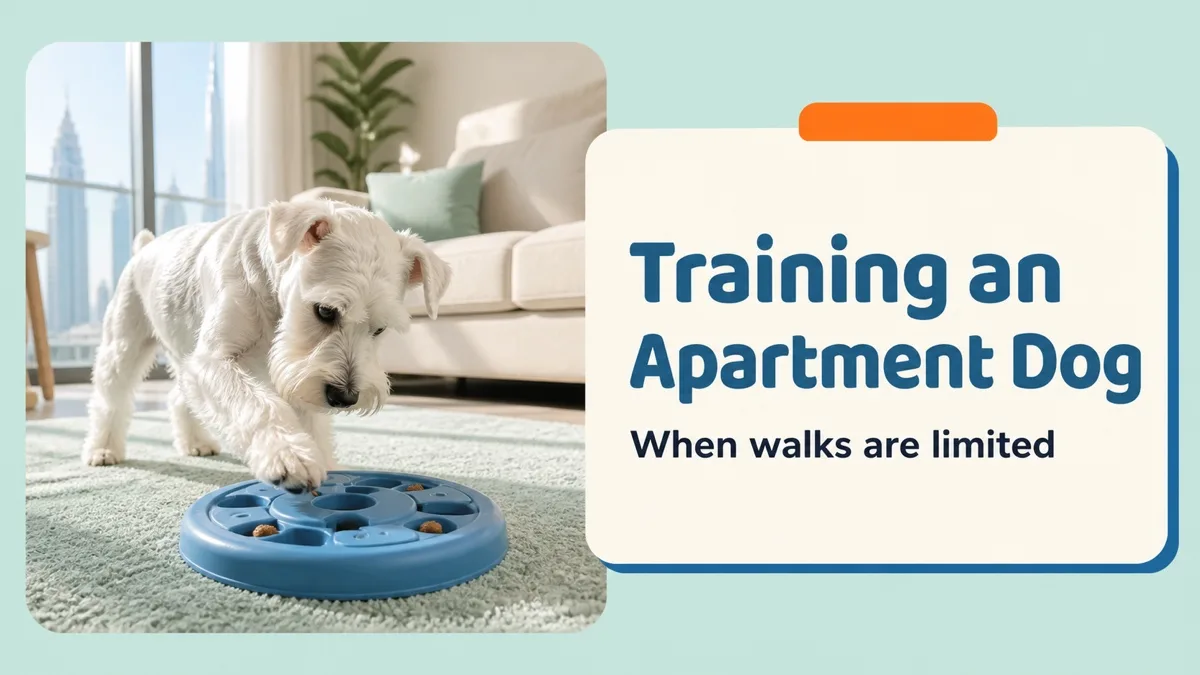
Almost every behaviour question we get from owners in tower blocks comes back to the same arithmetic. Dog training in Dubai is not made harder by the flat itself — it is made harder because for months of the year the walk that was supposed to absorb the day’s energy simply does not happen.
This page is about what to do with that gap. We do not run training classes, so none of it is a pitch for one; it is what we end up saying in the consulting room when a dog who was settled in March starts stripping the skirting boards in July.
The missing hours are the problem, not the square metres
A flat is a perfectly reasonable place to keep a dog. Plenty of well-adjusted dogs in this city have never had a garden, and floor area matters considerably less than owners assume — a large dog in a two-bedroom flat with a predictable routine usually does better than one in a villa who is left to occupy himself.
What breaks is the summer. The pavement becomes unusable in daylight, and walks compress into a narrow slot before sunrise and another late at night. A dog who had been getting an hour and a half of sniffing, choosing and moving is now getting twenty hurried minutes in the dark, and the difference has to go somewhere.
Where it goes is chewing, pacing, mouthing, barking at the front door and waking the household before dawn. None of that is disobedience. It is unspent capacity in an animal who has been given nothing to spend it on.
Structure carries more weight than duration
The most useful change available to you is not a longer walk. It is a day with a shape — meals, activity and rest at roughly the same hours, so the dog can predict what happens next instead of monitoring the flat for clues. A dog who cannot predict the day stays switched on for all of it.
Keep the training itself short. Three sessions of five minutes spread across a day teach more than one twenty-minute session, and they survive contact with a working week in a way the long version never does. Stopping while he is still interested is most of the technique.
Pick your moments too. Ten minutes after the evening walk, when he is already tired and the building has gone quiet, is worth half an hour attempted at six in the evening with lifts running and food deliveries arriving on every floor.
Mental work is a substitute, not a supplement
You cannot replace an hour of walking with an hour of walking indoors. You can replace a surprising amount of it with work — sniffing, problem-solving and chewing draw on the parts of a dog that a treadmill does not reach, and they tire him in a way that lasts.
Start by retiring the bowl. Every meal is material: scatter dry food across a towel so he has to hunt it, divide a portion into three hiding places around the living room, freeze wet food into something he has to work at for twenty minutes. A dog who has to find and extract his dinner has done a job, and dogs who have done a job sleep afterwards.
Then use the corridor. Most flats here have one, and it is the best training space in the building — recalls between two people, a wait at one end, a search game where you hide something while he is shut in the bedroom. Ten minutes of that on an afternoon nobody could walk in does more for him than the walk would have.
House-training on the eleventh floor has its own arithmetic
Ground level is not thirty seconds away. It is a lift, a lobby and a stretch of hot paving, and a puppy who signals at the door has already lost the race by the time the lift arrives. Owners read that as a training failure when it is a building problem.
There are two honest approaches. Take him down on a clock rather than on a signal — after waking, after eating, after play, then at fixed intervals — which works well and requires somebody at home. Or deliberately train a pad or an indoor grass tray in one fixed spot, and accept that you will have to retrain to outdoors later rather than pretending you will not.
What does not work is the balcony. The surface is too hot to stand on for much of the year, the smell settles into the building, and nothing learned on a balcony transfers to grass. Which route suits you depends partly on where you live — the low-rise blocks and short lift rides around our vet clinic near JVC make the clock method far more realistic than a Marina tower does.
Barking is a neighbour’s problem before it is a training problem
Sound moves through shared walls and service risers in a way it never does in a street of houses, and in a building with a management company a barking complaint is an administrative event with a paper trail. That changes your priorities — you are working to somebody else’s timetable, not your own.
Most flat barking is triggered rather than general. Lift chimes, the neighbouring front door, a delivery rider in the corridor, the hallway light coming on. Identify which one it is before trying to train the barking itself, because managing the trigger — moving his bed away from the door, leaving a radio on, blocking the sightline under the door — usually takes most of the heat out of it within days.
One pattern is worth separating out. Barking that happens only when the flat is empty, and begins within minutes of the door closing, is a different problem with a different answer, and no amount of trigger management will touch it.
Training that keeps failing is often a medical problem
A dog who chews at his own feet through the night, a dog who has become sharp about having his ears or his paws handled, a dog who will not lie still on a hard floor for more than a minute — these arrive labelled as behaviour and turn out, often enough, to be itch or joint pain. Sudden change in an adult dog is the signal worth acting on.
Ear infections, skin allergy and early joint pain are all common here, and all of them produce restlessness and a short temper long before they produce a limp you would notice or a scratch you would count. We look for them as a matter of course when an owner opens with behaviour, and what that examination covers is on our behaviour at check-ups page.
The same applies to a dog whose recall has quietly stopped working outdoors. Hearing goes gradually and owners rarely spot it, because a dog who cannot hear you looks exactly like a dog who is ignoring you. The broader picture of what we check and when is on our dog vet page.
What it costs
We do not sell training, and a behaviour conversation is not a separate product here — it happens inside an ordinary consultation at Petbook, which is AED 120. That is a published price rather than an estimate, and it is the same fee whether the visit turns out to be about a limp or about a dog who barks at the lift. The wider picture of what a consultation covers is on our vet prices in Dubai page.
Bring video. Thirty seconds filmed on a phone of the actual behaviour, in the room where it happens, tells us more than a careful description does, and it is the fastest way to find out whether you are looking at a training project or a medical one.