
The Dog Walk in Dubai: Timing, Water and Route
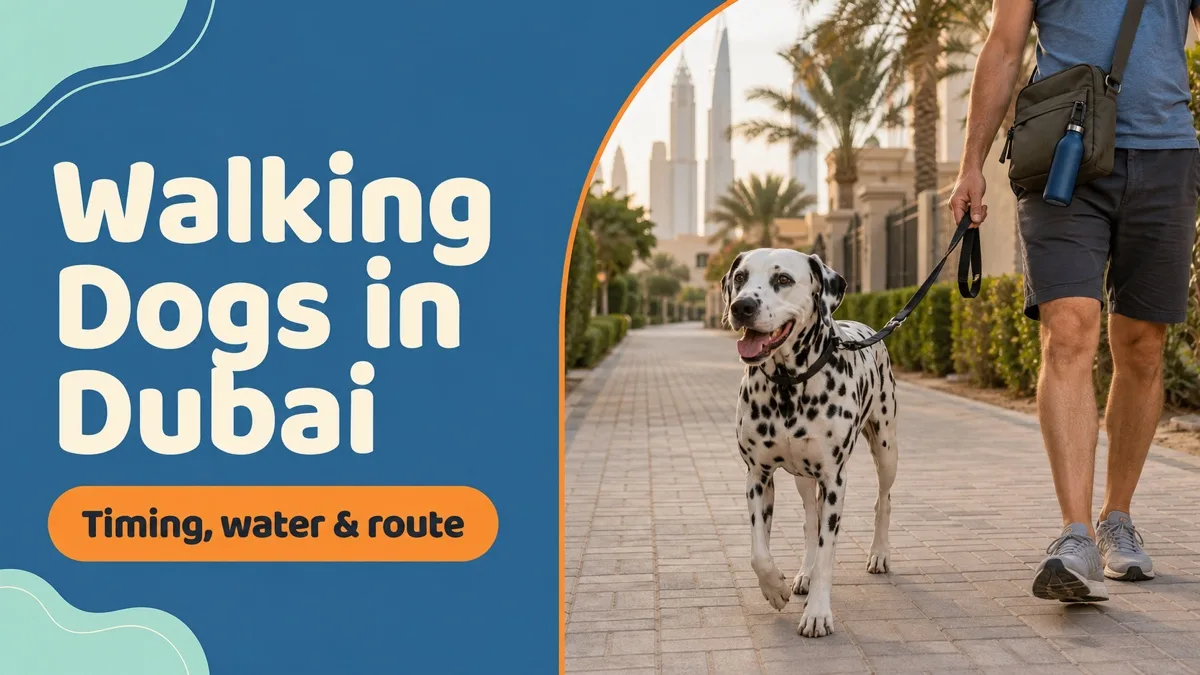
Most advice about exercising a dog in a hot country stops at “go early or go late”. That is true, and it is not enough. A dog walk in Dubai is really three decisions taken together — the hour you leave, the water you carry, and the route you take him on — and getting the first one right while ignoring the other two is how careful owners still end up in the clinic.
What follows is about those three, from May through to the end of September when the margin for error is at its smallest. It deliberately does not cover treating a dog who has already overheated or damaged his pads; that is an examination, not a route change.
Air temperature is the wrong number to be checking
The forecast describes air at roughly two metres above the ground. Your dog moves through the first thirty centimetres of it, over a surface that has been absorbing sunlight all day and is radiating it back up into his chest and belly. Those are two different climates, and only one of them is on your phone.
That lower layer keeps releasing heat for hours after the sun has gone. A walk at nine in the evening in July puts a dog into air that is still running on the afternoon while the air at your own head height has already turned pleasant — which is why the evening walk, not the midday one, is where most careful owners get caught out. Nothing on the forecast reports that gap, which is why the hour has to be chosen against the month rather than fixed once at the start of the summer.
The workable windows move by month, not by rule
From roughly May to the end of September the reliable window is before sunrise. The ground has had the whole night to shed heat and the sun has not yet begun putting it back. The second window, late evening, narrows as the summer deepens — and on a stretch of pavement that never came out of the sun at all, it can close completely.
April and October are the deceptive ones. The air drops into a range that feels like spring, which tempts people back into afternoon walks, while the ground is still running on summer time and takes several more weeks to catch up. From November to March the question mostly disappears, and that is the season to build the fitness, the recall and the routine that have to carry him through the next summer.
Humidity moves the hour as much as the calendar does
Two evenings with the same forecast are not the same evening. A still, wet coastal night in late August asks considerably more of him than the dry heat of May does, on the same route at the same hour — which is why the closing weeks of summer want an earlier start than the peak air temperatures of July, and why the walk you have done a hundred times is not automatically the right walk on the hundred and first.
Add a flat face, a heavy double coat, extra weight, or an age at either end of the range, and the hour moves earlier again. What overheating looks like and what it needs is on our pet heat stroke emergency page.
Water is something you carry, not something you find
There is no reliable water on a Dubai walking route. Public fountains are scarce, park taps are often off, and a dog who has been panting for twenty minutes is already behind by the time he gets home to his bowl.
Carry more than you think the distance justifies, in a bottle with a folding bowl, and offer it at intervals rather than waiting for him to ask — many dogs will not stop to drink while they are still interested in where they are going. Offer it again when you get in, and do not be surprised if the real thirst arrives ten minutes later. A dog who turns his head away from water on a hot evening and seems flat with it is telling you something that a shorter walk will not fix.
The route is planned around shade, exits and minutes
Build the loop around the shadow side of a building, irrigated grass and whatever cover the compound actually has, even when that means a longer and duller circuit than the direct one. Shape matters as much as length. A loop that comes back past your own entrance every few minutes lets you end the outing at any point, while an out-and-back that reaches its furthest point twenty minutes from home commits him to the return leg whatever has happened in the meantime — and the return leg is the half that goes wrong.
Plan in minutes rather than kilometres, and count the lift lobby, the basement car park and the car itself as parts of the route rather than as admissions of defeat. The shade you built the loop around in June also sits somewhere else by September, because the angle of the sun has changed and the shadows have moved with it, so the route wants rechecking every few weeks in the same way the hour does.
Irrigated grass carries its own trade-off, because the shaded, watered ground you were steering him toward is also where ticks live year round in this climate. Check him over when you get home — between the toes, inside the ears, under the collar — rather than trusting that the season is wrong for it, because here there is no season that is wrong for it. Why that matters so much locally is on our tick fever in dogs page.
When the walk has to be replaced rather than moved
Some dogs cannot be walked usefully in a Dubai August at all. A short pre-dawn outing for toileting and a sniff, repeated rather than extended, is a better plan than one long walk squeezed into a window that has already closed.
The exercise itself then has to happen indoors — scent games, training sessions, food puzzles, work that tires the head rather than the legs. What matters is that the summer version of his routine is planned deliberately, not improvised each evening at the lift.
What it costs
A consultation at Petbook is AED 120, which is a published price rather than an estimate, and that is the appointment for a dog who is limping after a walk, whose pads look wrong, or who has not been himself since an evening that turned out to be hotter than it seemed. Emergency assessment and treatment for a heat-related collapse depend entirely on what is found, so there is no published figure for it — message us on WhatsApp for a same-day quote once we know what is involved. The broader picture of what we do for dogs is on our dog vet in Dubai page.
The signs that end a walk early
Turn back when the panting gets faster and harder rather than settling, when he starts hunting for shade or lying down, when he lags on a route he normally leads, or when he lifts a paw and holds it. None of these are dramatic and all of them are early — the dramatic version is the one nobody wants to see.
Any of them that does not settle within a few minutes of stopping is a phone call rather than a judgement made on the pavement, and what to do in the first minutes belongs on our pet heat stroke emergency page rather than in a paragraph here. Our emergency line is answered 24/7, and if we are not the right place at that hour we will tell you where to drive instead.