
Dog Bad Breath: When It’s Dental Disease, Not Dinner
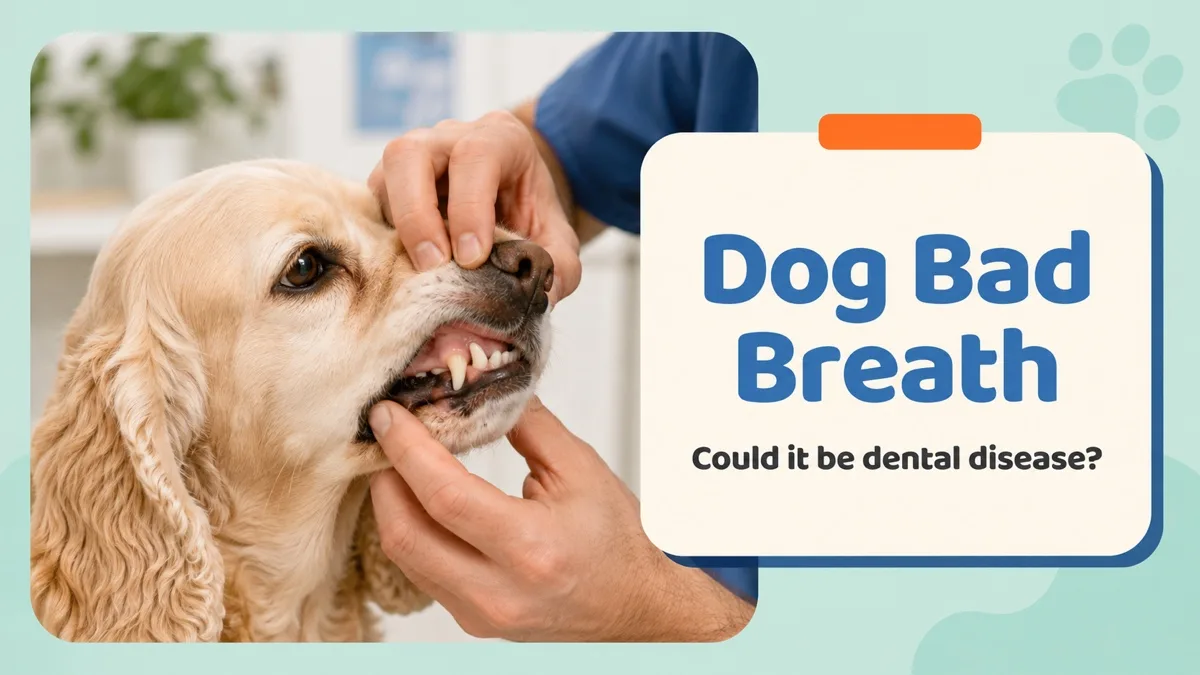
No dog’s mouth smells of nothing. But there is a difference between the ordinary smell of a dog who has just eaten and the smell you notice from the other end of the sofa — and persistent dog bad breath at that level is dental far more often than it is dietary.
This page explains what the smell is, how to check for yourself before you book anything, and the small number of cases where the mouth is not the problem at all. It deliberately does not name products or set out a treatment plan — that belongs to the veterinarian who has looked in your dog’s mouth.
What the smell actually is
Plaque is a film of bacteria that forms on a tooth within hours of a meal. Left alone it hardens into tartar — the brown-yellow band you can see where tooth meets gum — and the tartar then gives the bacteria a rough surface to hold and a shelter from the tongue. The smell is the waste product of that colony.
What matters is the direction the colony travels. It works downwards, into the narrow space between tooth and gum, and the damage it does there is out of sight: inflamed gum first, then loss of the ligament and bone holding the tooth in place. By the time the smell reaches you across a room, the process has usually been running for months.
Which is why “his breath is terrible” and “his teeth look fine” are not contradictory statements. The visible crown can be reasonably clean while the part you cannot see is not — and the smell tracks the part you cannot see.
The check you can do at home tonight
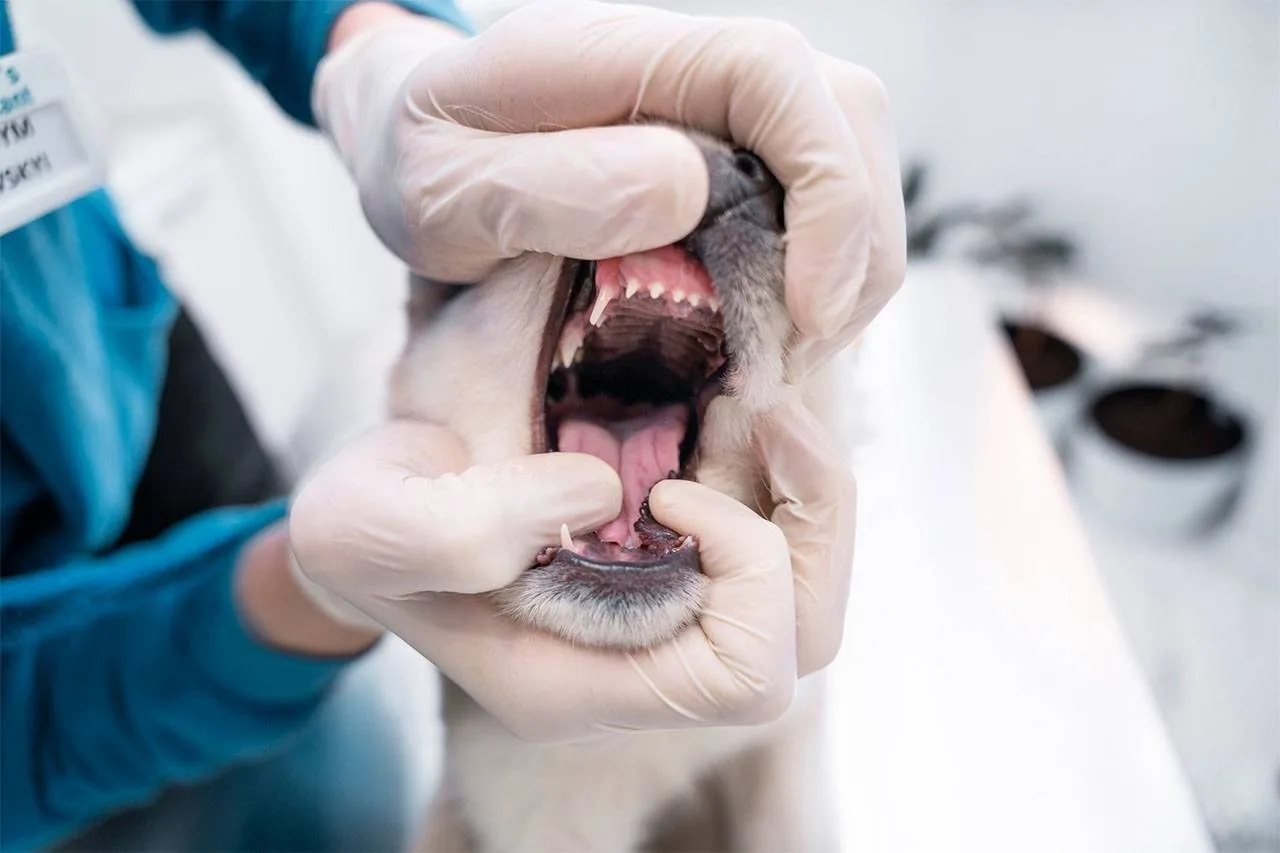
Lift the upper lip on one side, towards the back of the mouth, and look at the line where tooth meets gum. Three things are worth finding: a brown or grey band along that line, a red edge on gum that should be pale pink, and any tooth that appears longer than its neighbours because the gum has pulled back from it.
Then do exactly the same on the other side. Dogs shift their chewing to whichever side hurts less, so the two halves of the mouth often diverge — and the difference between them tells you more than either half on its own.
Finally, watch how he eats rather than whether he eats. A dog managing a sore mouth takes longer over a meal he used to finish quickly, works each mouthful at the front of the jaw, or breaks off partway through and comes back a minute later. Dogs rarely stop eating because their mouth hurts. They change the mechanics of the meal, and that is the change that gets missed.
Why it starts earlier here
Three local factors move the timeline forward, and none of them appears in advice written for a European reader.
The first is diet. Dry food dominates this market, and the belief that it scrapes teeth clean is only half right — most kibble shatters at the tip of the tooth rather than sweeping down its side, so it does very little at the gumline, which is precisely where the disease lives. The second is that brushing is uncommon among the dogs we see. Most owners have never been shown how, and nobody mentions it until the smell arrives.
The third is about which dogs live here. Apartments favour small breeds, and a small breed carries a full set of teeth in a shortened jaw — crowded teeth, tight gaps, more places for plaque to sit undisturbed. A four-year-old small dog in this city often has a mouth we would expect on an older one.
When the smell is not coming from the mouth
A minority of cases are not dental, and they are worth naming because the response to them is completely different.
A smell that is strange rather than simply foul — sweet, chemical, or closer to ammonia than to decay — can point towards the kidneys or the metabolism rather than the teeth. That is a reason for blood work rather than a scale and polish, and it is one of the reasons we examine before we book anything.
Then there are the mechanical causes: something wedged between two teeth or across the roof of the mouth, a wound, an ulcer, or a growth. These usually arrive with company — drooling, pawing at the face, blood on a toy, a change measured in days rather than months. Sudden is the word to pay attention to. A slow drift over a year is almost always periodontal; a change over a weekend is not, and it should not wait for a routine slot.
Brushing is the only home measure that reliably works
It is unglamorous and it is the answer. Daily brushing genuinely changes the trajectory, three times a week is worth doing, and once a month is a ritual rather than a treatment. Use a paste made for dogs, because human toothpaste is not designed to be swallowed, and build up over a couple of weeks — lip, then finger, then brush — rather than attempting the full job on the first evening.
Chews, water additives and dental diets have a real but secondary effect: they slow the formation of plaque. None of them removes tartar that has already hardened, and nothing sold over a counter will. Once tartar is on the tooth it comes off with an instrument, under anaesthesia, or it does not come off. What that procedure involves — scaling below the gumline, full-mouth x-rays and extraction of teeth that cannot be saved — is on our dental cleaning under anaesthesia page.
What it costs
A dental for a dog at Petbook is AED 499, carried out under monitored anaesthesia with the pre-anaesthetic blood work included rather than added afterwards. The consultation that has to come first is AED 120. Those are published prices rather than estimates. Extraction and gum work is the one part that carries no number in advance. Cats are priced separately and hide the disease differently, which we cover on our cat dental cleaning page.
What the appointment looks like
We look at the mouth awake first, as far as your dog will allow, and grade what is visible. That gives the general picture and the likely scale of the work, and it is enough to tell you whether a dental is needed at all. What it cannot settle is any individual tooth.
You leave with a written plan and a number rather than an impression. And if the mouth turns out to be reasonable and the smell is coming from somewhere else, we will say so on the day and change direction — the starting point is the same either way, and what a first appointment involves is set out on our dog vet page.