
Dog Ear Infection Treatment: Why It Keeps Coming Back
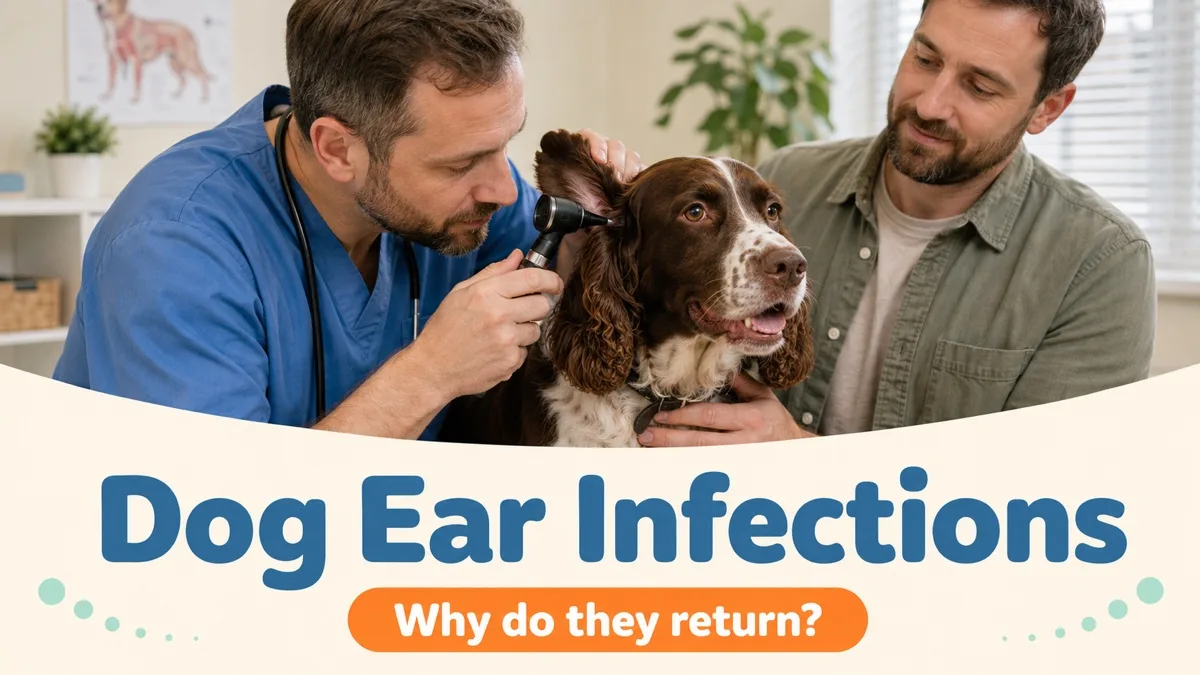
Most dogs we see for an ear problem are not meeting one for the first time. They have had two courses this year, or three since last winter, and the owner arrives expecting a stronger version of the same thing. That is the wrong request. In a repeat case, dog ear infection treatment has to be aimed less at what is growing in the ear today than at whatever keeps making the ear a good place to grow in.
This page explains why recurrence happens and what changes it. It deliberately does not name products or doses — that belongs to the vet who has looked down the canal in question, because what is safe to put into an ear depends on what is growing there and on whether the eardrum is intact.
An infected ear is a symptom, not a diagnosis
Yeast and bacteria live on normal skin, including the skin that lines the ear canal. They are not invaders arriving from outside. They are residents that multiply when the canal changes — when it becomes warmer, damper, more inflamed or narrower than it was.
So an infection is the visible end of something that started earlier. Clear the overgrowth and the ear looks normal within days. Leave the change that permitted it and the same population is back within weeks, which is exactly the pattern owners are describing when they say the treatment stopped working.
The swab under the microscope is the step that gets skipped
Yeast and bacteria look much the same to an owner, and often smell much the same too. Under a microscope they do not, and the difference decides what is used. A repeat case treated on appearance alone is a guess — and guesses quietly select for whatever survives them.
A swab also shows whether the infection has changed character since the last course, because a yeasty ear that has turned bacterial is a different problem in the same dog. We take that swab and read it in our own laboratory during the appointment rather than sending it away, and the eardrum is checked before anything goes in. What the visit involves is on our ear infection treatment page.
Coastal humidity is why recurrence is the local default
A dog’s ear canal is not a straight tube. It runs downwards and then turns, which means it holds whatever gets into it — water above all. Put that canal in air that stays humid for months and it never fully dries between one exposure and the next.
The Dubai calendar then removes the pause that owners elsewhere get for free. The humid months keep the canal damp indoors and out; the cooler months are when the beach, the pool and the long weekend walk come back, and the ear that stayed wet after a swim is the one we see the following week. In a cold country an ear problem tends to be a summer one with a dry winter to break the cycle. Here the two drivers simply take turns.
Allergy is the driver most repeat cases share
In dogs, ears are where allergy shows early and shows worst. An allergic ear is inflamed before it is infected — the canal swells, produces more wax, holds more moisture, and the resident organisms do the rest without needing any help.
That is how a dog can be treated correctly, clear completely, and be back six weeks later. The infection was real; it was just not the problem. A third episode in a year is worth investigating as a skin case rather than an ear case, particularly in a city where dust, permanent air conditioning and a year without a true off-season leave an allergic dog very little relief.
Stopping early, and cleaning with the wrong thing
An ear looks clean well before it is clean. Owners stop when the discharge stops, which tends to be about halfway, and the survivors repopulate a canal that is still inflamed. A course ends when the ear has been examined and declared finished — not when it looks better in the kitchen light.
The other half of this is what goes into the ear between appointments. Cotton buds pack debris deeper and press it against the eardrum. Kitchen oils and home mixtures add moisture to a canal whose entire problem is moisture. Drops left over from the last infection, or from another dog, may be wrong for this ear — and if the eardrum is perforated, some things should never go near it at all.
The signs that make it same-day rather than routine
Head shaking and a smell are ordinary and can wait for an appointment. A dog who tilts his head, staggers or circles is a different matter — the balance organ sits behind the eardrum, and anything reaching it needs looking at that day. So does sudden severe pain, an ear too sore to touch, blood, or an ear flap that swells up overnight.
It is worth knowing where untreated recurrence ends, too. Years of inflammation thicken the canal and eventually calcify it until it closes, and at that point a medical problem has become a surgical one. Nobody arrives there in a year. People arrive there in five, one skipped recheck at a time.
What it costs
The appointment where the ear is examined and swabbed is a consultation, AED 120, and that is a published price rather than an estimate. Treatment itself has no single published figure because it depends entirely on what is found, so message us on WhatsApp and we will give you a same-day quote once we know what we are treating. Whatever is dispensed comes from the in-house pharmacy, so you leave with it instead of driving somewhere else for it.
Between infections, the work is drying and looking
After every swim and every bath, the ears get dried at the opening — properly, and without pushing anything into them. Once a week, in daylight, you look and you smell. The owner who catches the change on day two brings us a mild ear; the same dog on day ten is a full course and a recheck.
Coat matters as well in breeds that grow hair inside the canal, and how much of it should be removed is a judgement made dog by dog rather than a rule. Done routinely in a healthy ear it is often unnecessary; done aggressively it causes the inflammation it was meant to prevent. It is worth agreeing on with whoever grooms him, and it is part of the ear care in grooming we do here.