
How Much Food Dogs Need in Dubai: Portions, Seasons and Treats
Most households decide how much food dogs need once, in the first month, by reading the chart on the back of the bag — and then never revisit it. The dog gets neutered, the summer arrives, the walks shrink to fifteen minutes at six in the morning, and the scoop stays exactly the same size.
That is the single most common feeding error we see, and it is not carelessness. Nothing on the packaging suggests the number is supposed to move. This page sets out when it should move and how you would know, without listing a chart of our own — because a portion written by a stranger who has not seen your dog is precisely the problem.
The chart on the bag is a population average
Feeding guidelines are calculated for a notional dog of a given weight, and real dogs cluster loosely around that figure rather than sitting on it. Two twenty-kilo dogs of the same age can differ substantially in what they need — a neutered, calm, indoor-heavy dog against an intact, busy one is not a small gap.
So read the chart as a starting point rather than a prescription. It gets you within range on day one, which is genuinely useful, and it is wrong for a meaningful minority of dogs from day one too. The general logic of how portions get set, and how the same question works for cats, is on our feeding guide for Dubai page.
Measure by weight, and read the chart as a daily total
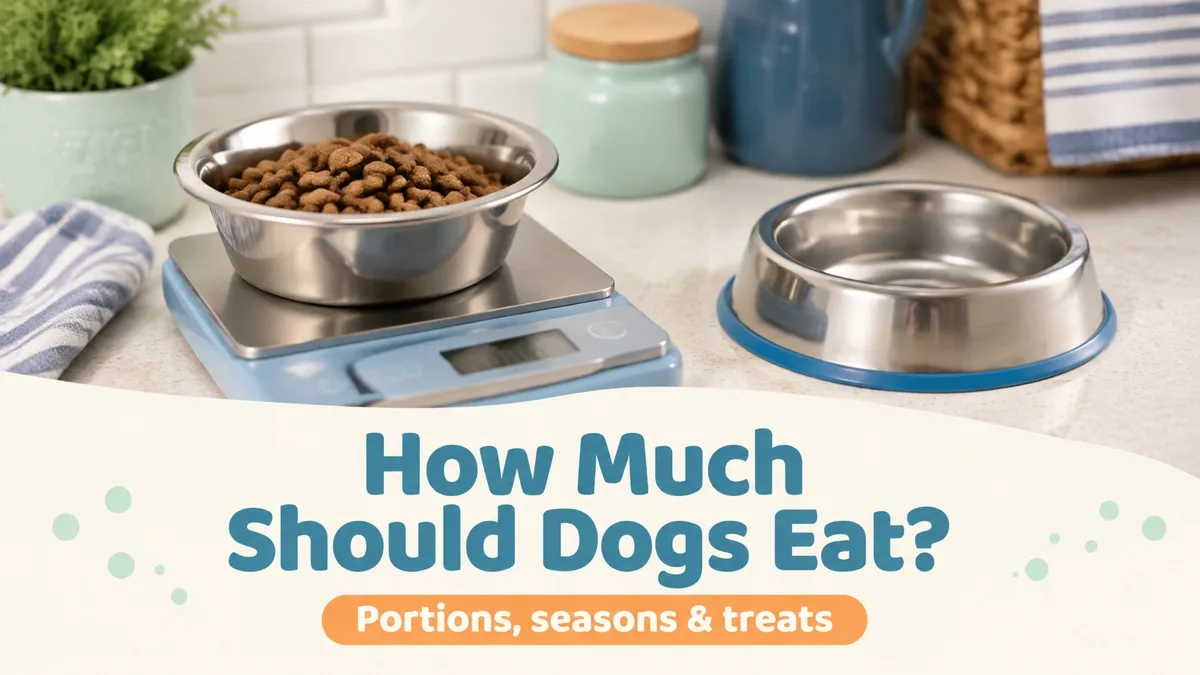
A scoop is not a unit. The same cup of kibble varies by a surprising margin depending on how densely it settles and how heaped the hand is, and that variation compounds twice a day for a year. A cheap kitchen scale removes the guesswork permanently, and after a fortnight you will not need it every time.
The more expensive mistake is misreading the chart itself. The figure printed against your dog’s weight is almost always the amount for the whole day, to be divided between meals — not the amount per meal. A household feeding twice a day off a per-meal reading is feeding double, and the dog will look fine for several months before he stops looking fine.
Treats come out of the ration, not in addition to it
Training treats, dental chews, the last third of the children’s sandwich, a scoop of the helper’s rice — these are food, and they are almost never counted. In a household where several people feed the dog without discussing it, the untracked portion can quietly become a substantial share of the day’s intake.
The fix is administrative rather than nutritional. Decide the daily amount, weigh it out in the morning, and let everything the dog is given that day come out of that container — training included, which works better than most people expect because dogs will work for their own kibble. When the container is empty, the day is over. That one habit does more for a dog’s weight than any change of brand.
Dubai moves the number twice a year, and the bowl rarely notices
From roughly May to September, a dog in this city covers a fraction of the distance he covers in January. Walks that ran an hour in the cool months are cut back to whatever can be done before the ground warms, and his energy requirement drops with them. The amount in the bowl almost never drops with it.
The reverse is also true and gets forgotten. When the weather turns and the long walks, the beach and the park come back, some dogs — particularly young, active ones — genuinely need more than they were getting in August. Treating the portion as a fixed household constant means the dog is overfed for half the year and underfed for part of the other half.
Diarise it. Two reviews a year, once as the heat sets in and once as it breaks, will keep a dog closer to the right weight than any amount of reading about protein percentages.
A growing dog is a moving target on purpose
A puppy needs a food formulated for growth and a portion that increases every few weeks, which is one of the few periods where frequent adjustment is correct rather than fussy. Weighing him fortnightly during that stretch is not anxiety — it is the only way to see the increase coming before he outgrows the amount he is on.
Large breeds are their own case, and the instinct to push growth is the wrong one. Growing too fast is a genuine skeletal risk rather than a bonus, which makes the portion for a large-breed puppy a conversation with a vet who is watching the growth curve rather than a number lifted off a chart.
How you know the number is right: the six-week loop
Set the amount, feed it consistently, and reassess after about six weeks. Weekly weighing tells you very little and produces anxious owners; six weeks of a steady amount tells you something real. Between weigh-ins, judge him by hand rather than by the scale — what your hands find along his ribs is a better guide than a kilogram figure with no history behind it.
When the chart and the dog disagree, the dog is right. Adjust in small steps rather than dramatic ones, change one variable at a time, and write down what you did — a household that cannot remember whether the portion went up or down in March has no way of interpreting what the scale says in June. We record weight and body condition at every visit precisely so that history exists, and that is part of routine weight checks.
What it costs
At Petbook the weight and portion review sits inside a normal consultation rather than on a separate line of the bill, and the consultation is AED 120 — a published price rather than an estimate. What it buys is arithmetic you cannot do from the packet: the amount is worked out from his actual weight and condition instead of a printed band, and a date to review it goes in the notes so the next visit is not starting from memory. If the appetite or the weight suggests something medical sitting behind them, testing is quoted separately — message us on WhatsApp for a same-day quote.
Two dogs, one bowl, and no idea who ate what
Multi-dog households are where portion control quietly stops existing. Two bowls put down together in the same room rarely stay two portions: the faster dog finishes and starts on the slower one, and within a few weeks one animal is eating well over his amount while the other is quietly eating well under it. Feeding them in separate rooms, or at least separated by a doorway, costs nothing and is the only way the numbers you set mean anything.
It also protects the most useful early warning you have. In a shared bowl you cannot see appetite change, and appetite is one of the first things illness touches — so if one of them starts losing weight while apparently eating his measured amount, that has stopped being a portion question. Bring him in before changing the bag; the examination itself is described on our dog vet page.