
Pet Grooming Frequency in Dubai: How Often Your Dog or Cat Actually Needs a Groom

Most advice about pet grooming frequency was written for a climate this city does not have. Groom every six weeks, bathe more in summer, less in winter — that schedule assumes a real winter, a coat that moults on cue, and a dog who spends most of his day outdoors.
None of that holds here. Four to six weeks is the baseline we work to for most pets in Dubai, and the useful question is what moves your animal off it: the coat he has, the skin underneath it, and the months of the year he lives almost entirely in air conditioning.
The interval is set by the coat, not the calendar
A groom does two jobs that have very little to do with each other. One is cosmetic — length, shape, the tidy outline you are paying for. The other is maintenance: pulling out dead undercoat, clearing the hair that grows between the pads and around the ear opening, and taking nails back to a length that does not change how he stands.
The cosmetic half can wait as long as you like. The maintenance half cannot, and it is the half that sets the floor on frequency. A coat holding on to its own dead hair stops being a grooming matter fairly quickly — air stops moving through it, moisture stops leaving it, and the skin underneath becomes the problem instead.
Whether a coat should be clipped short at all is a separate argument from how often it should be seen, and what a single session actually includes is set out on our pet grooming service page.
What this climate actually changes
Three things, and none of them appear in a schedule written for Europe. The first is that the moult never properly finishes. Indoor temperature and indoor light barely shift across the year, so there is no clean seasonal trigger — instead of two heavy sheds you get a low-level shed running twelve months, filling the coat continuously rather than in a burst.
The second is fine dust. It settles down into the undercoat rather than sitting on top of it, and because it is abrasive it works against the skin every time he moves.
The third is that the coat swings between two opposite conditions in a single afternoon. Conditioned air indoors is dry, and a dry fibre is rough enough to catch on its neighbours instead of sliding past them. Outdoors through the coastal months it is the reverse — a thick coat holds damp for hours after a walk, in the folds, under the ear flap and along the belly line where nobody looks. Dry air starts the knot; humid air sets it.
Taken together, those push the interval shorter than the standard advice rather than longer. That is the opposite of what most owners assume about a hot country, and it is the single most common scheduling mistake we see.
A working baseline for dogs
A full groom every four to six weeks fits most dogs here. A short single coat sits at the slower end — every six to eight weeks, and that visit is mostly nails, ears and paw pads rather than the hair itself.
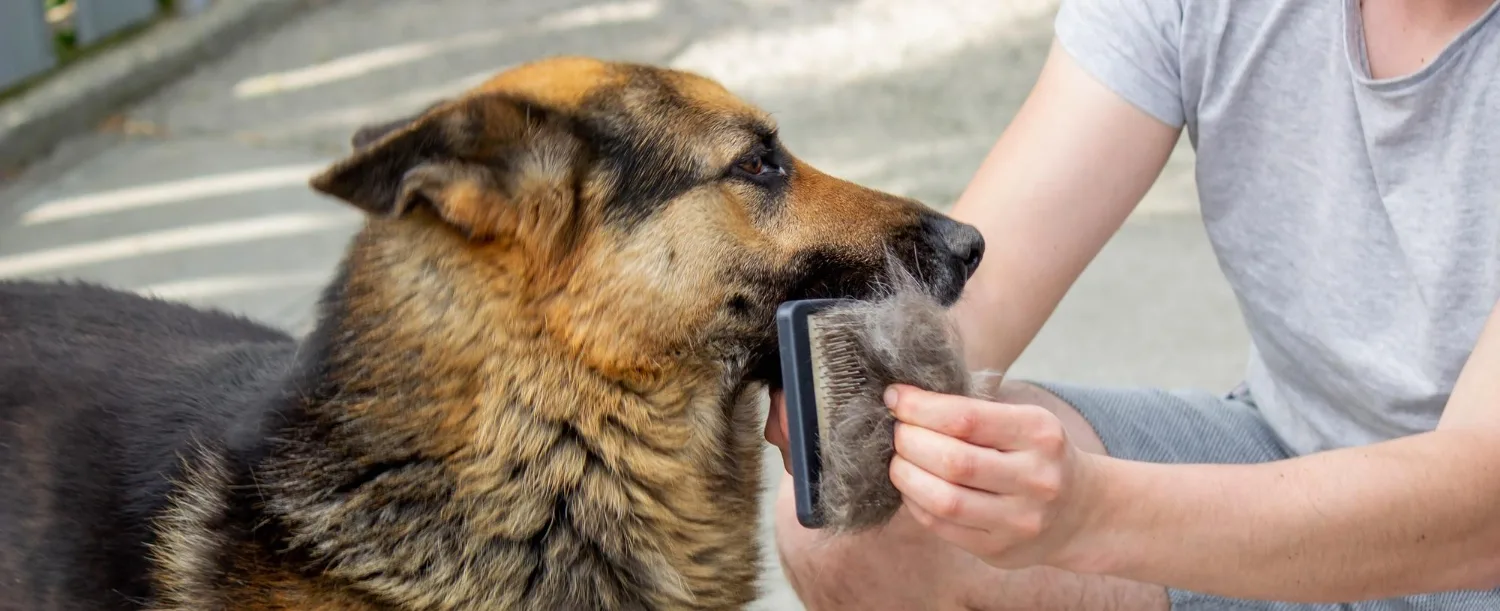
A double coat moves the other way through summer. De-shedding every three to four weeks is the honest interval for a husky or a German shepherd in July, because the dead undercoat is the entire problem and it is not coming out on its own. Through the cooler months it stretches back towards six.
A continuously growing coat has no flexibility at all. Poodle crosses, shih tzus, maltese and their many variations do not shed the coat out; it simply keeps growing, and it mats on a schedule you can predict. Four to six weeks holds, and it does not stretch. Owners who take it to ten weeks and then ask for the same haircut are usually told the coat has to come off short — a decision made by the mats rather than by anybody in the room.
Nails deserve their own line here. A dog walking on marble, tile and lift floors wears nothing down, so nails that would look after themselves on rough pavement need cutting on a schedule in Dubai.
A working baseline for cats
Most short-haired cats need very little from a salon — every eight to twelve weeks, and that appointment is claws, ears and a de-shed rather than a haircut. A comb at home covers the rest of the year.
Long-haired cats are a different proposition. Persians, Himalayans, Ragdolls and Maine Coons are everywhere in this city, and that coat is dense enough that the cat cannot maintain it alone no matter how fastidious she is. Four to six weeks is the professional interval, with brief combing at home in between — and between visits the comb does more of the work than the salon does.
The signs you have left it too long
The comb stops in the same place twice. He smells within a few days of a bath rather than a few weeks. He shakes his head, or works at one ear with a back foot. You can hear nails on tile from another room.
None of those is a cosmetic complaint. Each one is the coat telling you that the interval you are running is longer than the coat can hold.
The opposite error is real too, and it is worth saying plainly because it cuts against the clinic’s commercial interest. Skin that is flaky, dull or itchy with no fleas and no obvious rash is sometimes simply over-washed — conditioned air is already pulling moisture out of it all day, and frequent shampooing on top of that finishes the job. Bathing and grooming are not the same appointment, and the answer is usually to hold the maintenance interval where it is and reduce the shampooing rather than the other way round.
When the interval stops being your decision
Some coats run on a schedule set by a diagnosis rather than by convenience. A dog under treatment for allergic skin disease may need medicated bathing at a specific frequency, and that frequency is part of the treatment — moving it because the salon was full changes the result. We would rather set that schedule at an examination than have anybody guess at it, and what the workup involves is on our skin allergy treatment page.
What it costs
Grooming at Petbook starts at AED 69 for a basic cat session, a full cat groom is AED 120, and dog grooming starts at AED 145 and rises by weight band from there. Those are published prices rather than estimates, and the full band-by-band breakdown is on our grooming prices page.