
Microchipped Cats and Dogs in the UAE: What the Law Actually Rests On
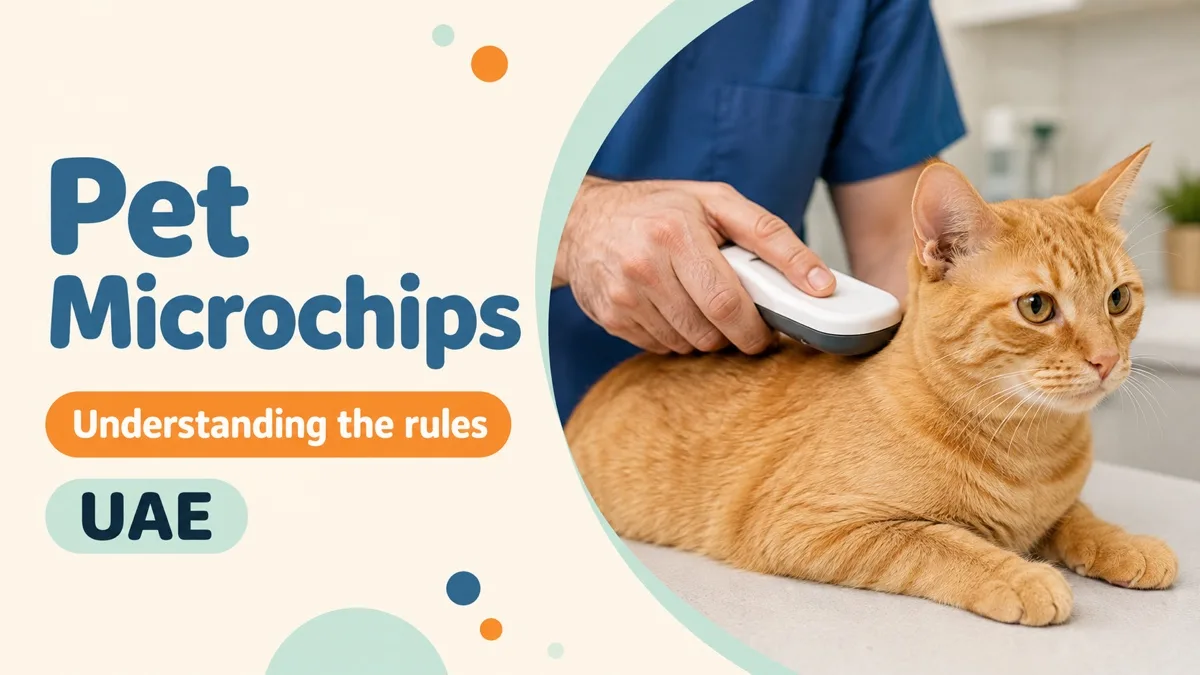
The question arrives most often from owners of indoor cats, and it is a reasonable one. If she never leaves the flat, why do microchipped cats matter at all — and why does almost every official process in this country ask about a chip before it asks anything else?
The answer is that the chip is not really a health measure. It is an identity, and nearly every rule about owning an animal in the UAE is written on the assumption that the animal has one. This page explains what that number does, what it cannot do, and the two ways owners end up with a chip that has quietly stopped working.
A microchip is a number, not a tracker
This is the misconception worth clearing first, because it changes what people expect from it. The chip is a passive component the size of a grain of rice. It has no battery, no signal and no position. It does nothing at all until a scanner is held over it, at which point it returns a number and goes quiet again.
So it will not tell you where your cat is. What it does is answer a different question — who this animal belongs to — at the moment somebody with a scanner is standing over her. A vet clinic, a shelter, a municipality officer or a boarding facility can read that number and reach you. Nobody, anywhere, can read it from a distance.
The law is built on identity, not on the chip itself
Rules about owned animals here have to attach to a specific animal, and a name written on a card does not do that. Two grey cats in the same building can share a name. A number cannot be shared, cannot be transferred by accident, and does not fall off.
That is why the chip sits underneath everything else: the vaccination certificate quotes it, the registration record is filed against it, the licence documents for a dog repeat it, and an export file for travel begins with it. The chip is not one requirement among several — it is the thing the others are written on. The order those requirements come in, and what a complete file looks like, is set out on our pet registration in Dubai page.
Cats are where this catches people out
Dog owners tend to arrive already knowing. The permit process makes the chip unavoidable, so it happens early and nobody argues about it. Cat owners often go years without the subject coming up.
Then a door is held open by a delivery rider, and an indoor cat is outside for the first time in her life. This is where Dubai differs from the cities most online advice is written for. In most neighbourhoods here there is a substantial free-roaming cat population within metres of the front door, and an unchipped cat sitting under a parked car is indistinguishable from any of them. She looks like a community cat because there is no way to establish that she is not one.
A chipped cat in that situation is a phone call. An unchipped one is a set of posters in a lobby.
The number is useless if the record behind it is stale
This is the second failure, and it is more common than having no chip at all. The chip stores a number; the number is only meaningful because a database somewhere connects it to your name and your phone. If that database still holds a phone number you stopped using the day you changed provider, the scan succeeds and the trail stops there.
Dubai makes this worse than most places. People change SIM cards with jobs, move between buildings on short notice, and leave the country at a few weeks’ notice — and updating a pet database is not on anybody’s moving checklist. Check what your chip’s record says the year you change your number, not the year your cat goes missing.

What implantation actually involves
Less than owners expect. It is implanted under the loose skin over the shoulders with a single-use applicator, during an ordinary consultation, and most animals react to it roughly as they react to a vaccination. There is no anaesthetic involved for the implant itself, and no recovery period afterwards.
Because of that, it is usually done at the same appointment as a vaccination rather than as a visit of its own — the animal is already on the table, already examined, and the certificate that follows can be written against the new number straight away. That combined appointment is on our vaccination and microchip page.
Scan before you implant, always
Two chips in one animal is a worse position than none, because it creates two competing identities and no way to know which one a future document is quoting. It happens when an imported or rehomed animal is assumed to have no chip and is quietly given one.
The fix costs a minute. Any animal arriving with an unclear history is scanned before anything else is decided — imported pets very often already carry a readable chip from their country of origin, and rescues occasionally do too. If a number comes up, the work is administrative rather than surgical: establish what that record says and correct it.
Travel is where it stops being optional
Every destination builds its entry rules on a documented identity, and the sequence matters as much as the fact — which document was issued first, and whether the chip number on each of them matches. Requirements differ by country and are revised, so they have to be read from the destination authority itself rather than from any clinic page, this one included.
What we would say is this: the moment you discover an identity problem is almost always the worst possible moment to discover it, because by then there is a flight booked and a timeline that cannot be shortened. Sorting it while nothing is happening costs one appointment.
What it costs
The consultation is AED 120, and the vaccination package, which covers the core course plus deworming, is AED 199. The microchip and the pet passport are listed in the first-visit package at that same price. Those are published prices rather than estimates.
What to keep once it is done
Three things: the number itself somewhere you can find it without opening a drawer, the certificate that records who implanted it and when, and a note of which database holds the registration. Photograph all of it. Paper records are lost in exactly the households that move most often.
Then treat the number as part of your own contact details rather than the animal’s. It changes when you change, not when she does. Everything else a first year in this city asks of an owner — the records, the appointments and the order they come in — is collected on our pet owner guide.