
Your Cat Turns Seven: What Senior Cat Care Actually Changes
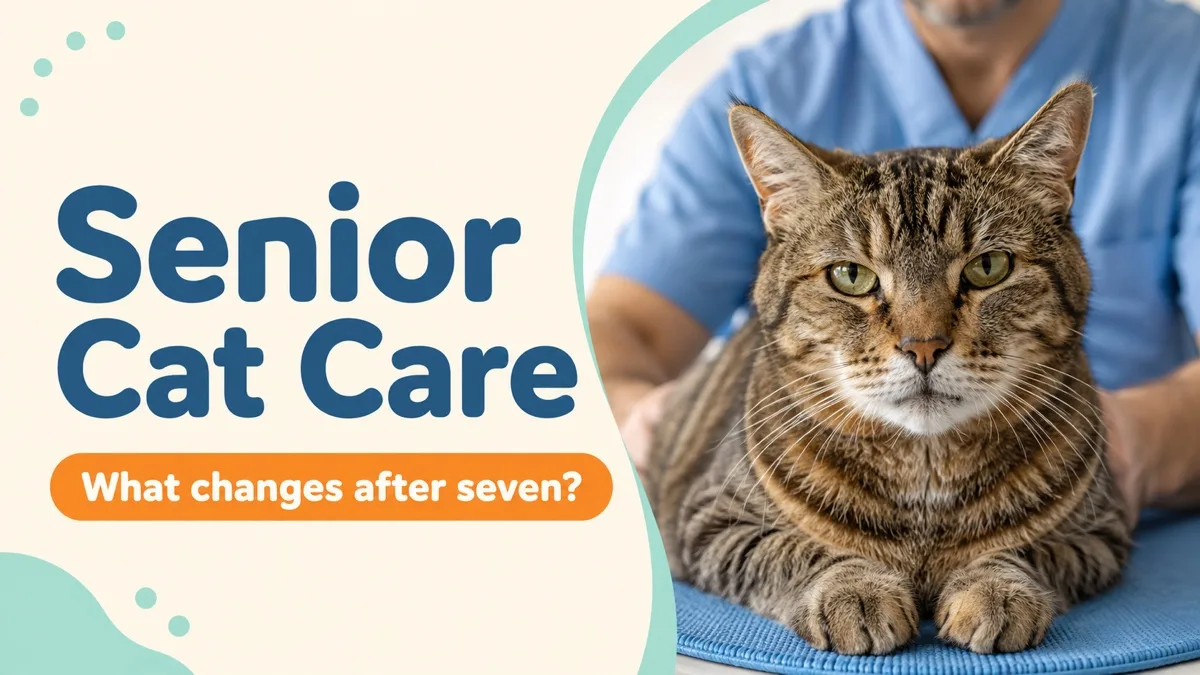
Seven is the age at which veterinary records start calling a cat senior, and nothing about her cooperates with the label. She eats the same, sleeps in the same patch of sun, and jumps onto the same counter. What changes is what senior cat care is looking for, and how long she can go unchecked before something that began quietly stops being early.
This page is about what happens differently in the consulting room after seven, and why. It does not name products or doses — the plan for an individual cat belongs to the vet who has examined her and seen her numbers.
Seven is a bookkeeping number, not a diagnosis
Nothing switches on at the birthday. Cats age at very different speeds, and a lean, well-kept cat of nine can be in better physiological shape than a stressed one of seven. The label exists to change our behaviour rather than hers.
What it changes is the interval. A year between examinations is sensible at five; at eleven it is a long stretch for kidney values to drift, for a tooth root to abscess, or for a thyroid to speed up. How that six-monthly schedule works, for dogs as well as cats, is on our senior pet care page.
The examination gets longer before it gets more expensive
She goes on the same scale every visit, and the number is written down rather than eyeballed. A cat who has gone from 4.6 kg to 4.2 kg across a year has lost nearly a tenth of her body weight — and steady loss in a cat who is still eating well is one of the earliest measurable signs that a kidney or a thyroid has changed.
Then come the things only worth doing on an older cat: feeling both kidneys for size and shape, feeling the neck for a thyroid that has grown, and looking properly at a mouth that has had a decade of use. Most of it is done by hand and adds nothing to the bill. It is the reason a senior appointment is worth keeping in a year when she seems perfectly well.
Blood tells you what; urine often tells you when
A senior panel covers kidneys, liver, thyroid and blood sugar, and it is the part owners expect. The urine sample is the part that gets left out, usually because collecting it at home sounds impossible. It is frequently the more useful half — a kidney that is starting to struggle loses its grip on concentrating urine before the blood figures have moved very far.
Collecting it is less awful than it sounds. An empty, freshly washed tray with a scatter of non-absorbent granules, left down for a few hours, works for most cats; if it does not, we can usually obtain a sample here. Both run in our own laboratory, so the results are normally discussed with you at the same visit rather than a week later. What the senior blood panels cover is set out on that page.
Air conditioning, dry food, and a cat who does not drink
Chronic kidney disease is the condition that shapes the back half of most cats’ lives, and nearly everything about how cats live in Dubai pushes in the wrong direction. Flats are air-conditioned and dry for most of the year. Diets here lean heavily on dry food, which carries a fraction of the water that wet food does. Cats are unenthusiastic drinkers by descent, built from animals that took most of their water out of prey.
So she runs on a thinner margin than a cat in a cool, humid climate would — and a kidney losing capacity has to produce more urine rather than less, which narrows that margin again. This is why the earliest thing owners actually notice is domestic rather than medical: the water bowl emptying faster, or a clump in the tray that has doubled in size. Either one is worth an appointment rather than a month of watching.
The mouth is where an older cat’s pain usually is
Cats do not display dental pain in a way that reads as pain. They keep eating, because the alternative is going hungry. What you see instead is a cat swallowing biscuits whole, chewing on one side, dropping food, or becoming quietly less willing to be touched around the head. By the time she refuses a meal outright, the problem is rarely new.
Resorptive lesions — where a tooth erodes at the gumline — are common in older cats and genuinely painful. They are found with radiographs under anaesthetic, not with a torch and a conscious cat. Age on its own is not a reason to avoid that; it is a reason to run blood first and build the anaesthetic around what the results say. How the procedure runs is on our dental cleaning page.
What it costs
The consultation is AED 120, and a dental cleaning for a cat is AED 349. Those are published prices rather than estimates. Blood and urine panels vary with what we run, so message us on WhatsApp for a same-day quote instead of working from a figure on an overseas website.
Getting her here is the obstacle worth solving
A good part of the reason older cats miss appointments is the carrier. A cat who only ever sees one on the way to the vet has learned exactly what it means, and a frightened eleven-year-old gives us a worse examination — a tense abdomen that hides what a hand can feel, and a heart rate fast enough to bury what we are listening for.
Leave the carrier out as furniture for a fortnight, feed her in it, and line it with something from her own bed rather than a fresh towel. Book a time you can drive straight to, so she is not waiting in a hot car — or ask for a home visit, where the vet comes to the flat and the carrier stops being part of the problem at all. None of this is fussing; it is the difference between an examination she tolerates twice a year for the rest of her life and one she fights every time.