
When to Take a Dog to the Emergency Vet: The 2am Decision in Dubai
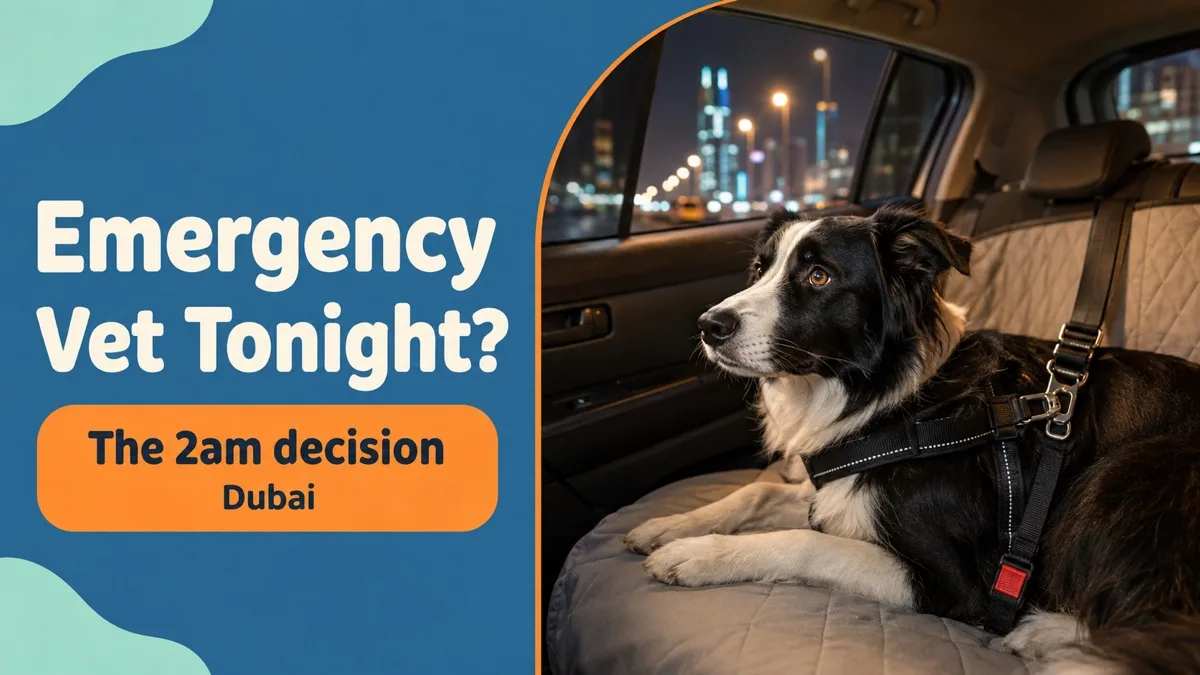
The hard part of a night emergency is rarely noticing that something is wrong. It is deciding whether it can wait. Knowing when to take a dog to the emergency vet — rather than watching him until the clinic opens — is a judgement most owners make once, at speed, with no practice.
This page is written for that moment. It sets out the signs that should put you in the car immediately, the ones that can usually hold until morning, and the versions of both that are specific to living in Dubai. It deliberately contains no doses and no home treatments, because those belong to the veterinarian who has examined your animal.
The question is not how ill he looks — it is how fast he is changing
Dogs and cats are good at concealing illness, and the concealment holds until it collapses. So severity at a single moment is a poor guide. The more useful measure at two in the morning is direction: compare him to how he was an hour ago, not to how he was yesterday.
An animal who is visibly worse after sixty minutes is moving. Things that move at that speed do not stop because the hour is inconvenient, and the stretch between now and the clinic opening is long enough to matter. An animal who is unchanged, eating, and settled is telling you something different.
There is a second rule that overrides the first. A short list of problems is an emergency at any severity — they look survivable and are not — and knowing that list is worth more than any general instinct about how bad something seems.
The signs that do not wait
Breathing comes first and it is not negotiable. Any animal working to breathe — a cat breathing with his mouth open, a dog standing with his neck extended and his elbows held away from his chest, gums that look grey, white or blue rather than pink — goes now. Difficulty breathing is the one sign that never earns a wait-and-see.
Then the group that counts regardless of how well he otherwise seems. A male cat straining in the litter tray and producing nothing. A deep-chested dog with a hard, swollen abdomen who retches without bringing anything up. A seizure — and more so a second one in the same night — or a sudden collapse and an inability to stand.
The same applies to bleeding that will not stop under steady pressure, to a fall from any height, to a suspected poison or a swallowed object, and to a birth that has stalled. Each of those has a mechanism that worsens with time rather than settling with rest, which is what separates them from the much longer list of things that genuinely do look better in the morning.
The blocked male cat is the one owners miss most often, because straining in the tray reads as constipation. It is not. A cat who cannot pass urine is in a genuinely time-critical situation, and the behaviour looks mild for a while before it does not.
Trauma deserves its own warning. An animal struck by a car or a gate, or caught by a larger dog, can get up and walk normally afterwards. Internal bleeding and chest injuries are quiet for hours. “He got up and seemed fine” is a description of the first stage, not a reason to go back to bed.
The Dubai versions of the same list
Heat is the emergency this city adds. From roughly May to October a dog can cross from overheated into a medical crisis in the time it takes to walk back from the car park, and what looked like ordinary panting twenty minutes earlier is no longer the same thing. The first minutes decide a great deal here — what to do in them, including whether to cool him at all before you drive, is on our heat stroke page.
Falls come second. This is a city of towers, and an open window or an unscreened balcony is a route a cat will take after a bird without any sense that the ground is forty floors down. A cat who has fallen goes in even if he walks away from the landing — the injuries that matter are internal and are not visible from a balcony.
Then the two that come with the neighbourhood. Pest control runs here on a schedule residents are rarely told about, and a dog who has picked something up outside is a night decision rather than a morning one. And an unvaccinated community cat population a few metres from most front doors means a puncture wound from a fight is contaminated from the moment it is made — it can look like nothing at midnight and be a serious infection by the second day.

What can usually wait until morning
One vomit from an adult who is otherwise entirely himself — alert, drinking, comfortable on his feet. One soft stool. A mild limp he is still weight-bearing on. Scratching at an ear. A slightly reduced appetite for one meal. These are all worth a same-day appointment rather than a night drive, and the word carrying the weight in that sentence is “usually”.
Age and size move the line. A very young, very old, very small, pregnant or already-unwell animal has far less reserve, and a degree of dehydration a healthy adult shrugs off in six hours is significant in a kitten. Anything that would be a minor problem in a big dog should be treated more seriously in a small one.
Call before you drive, not after you arrive
This is the part that changes the outcome most and costs nothing. Our line is answered 24/7 — an actual person, not a recording. Describing what you are seeing takes ninety seconds and produces something a web page cannot: a decision about whether this is a now problem or a morning problem, and where to take him if it is a now problem.
We will be straight about the limits of that. The clinic is not open around the clock — the line is. If your animal needs to be seen at an hour when we cannot see him, we say so and direct you to the nearest clinic or hospital that can, which is a considerably more useful answer at 2am than an unanswered phone. How the service works is set out on our emergency line page.
While one of you is on the phone, the other can prepare. Cat into a carrier rather than loose in a car. Do not force food or water into an animal who may need an anaesthetic. Bring the packaging of anything he may have eaten, a photograph of the plant, and his vaccination card. And let somebody else drive if there is anybody else — arriving safely is part of arriving.
What it costs
At Petbook the consultation is AED 120, and that is a published price rather than an estimate. The number after it is the one nobody can give you honestly over the phone at 2am, because a night decision is made on a symptom rather than a diagnosis — the same laboured breathing can be a chest that needs draining or an airway that settles with oxygen and an hour of quiet, and those are not the same bill.
So the order is examination first, figure second, and nothing started that you have not agreed to. Blood work is read in our own laboratory rather than sent out, which is usually why the plan and its price arrive within the same visit rather than the next day. For a range before you set off, message us on WhatsApp for a same-day quote.
And the expensive outcome is not the unnecessary visit. It is the necessary one that arrived hours later than it needed to, when a problem that could have been managed has become a problem that has to be operated on.
If you are still not sure
Then the uncertainty is itself the answer. Nobody who has done this work for long thinks less of an owner who came in at three in the morning with a dog who turned out to be fine — that is a good night, and it is the outcome we would rather have than the alternative. The owners we worry about are the ones who talked themselves out of it and arrived in the morning.
If you are reading this while looking at your animal and weighing it up, stop reading and call now. Ninety seconds on the phone will tell you more about your own situation than the rest of this page.