
How Cat Ringworm Spreads in Dubai Apartments — and Reaches People
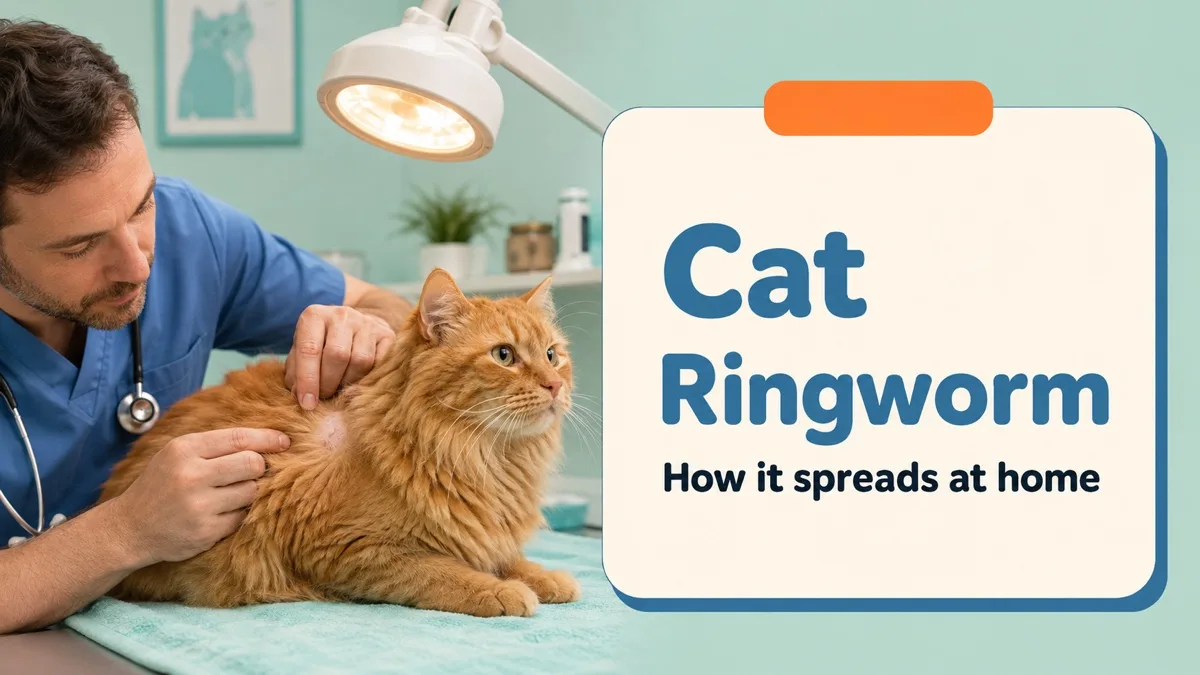
Ringworm is the one skin problem we regularly watch move from a cat to the people she lives with, and in a Dubai flat it moves further and faster than owners expect. Cat ringworm spreads by shedding — an infected cat drops microscopic spores onto every surface she touches, continuously, and she is doing it for days before anybody notices a patch.
That single fact explains nearly everything else about it. Once you accept that spores are being dropped onto floors, sofa fabric, bedding and air-conditioning dust every hour of the day, the story we hear most often — treated, looked better, back again six weeks later — stops being bad luck and starts being an untreated home. This page is about how the infection travels through a household. It deliberately does not name products or doses; that belongs to the vet who has examined your cat.
The cat is the source, the flat is the reservoir
Infected hairs are brittle and break off. Every fragment that falls can carry spores, and spores are durable in a way bacteria are not — they persist in the environment for months rather than days, and ordinary sweeping does not deal with them.
So a household with ringworm in it has two problems rather than one: a cat who needs treating, and an environment that keeps handing the infection back to her. The second problem is the one nobody warns owners about, and it is why we ask about the flat itself at the first appointment rather than at the third — which rooms she sleeps in, what is carpeted, who else lives there.
Why a Dubai apartment concentrates it
Most of this city lives in flats, and a flat is a small sealed box with recirculated air. There is no garden to dilute anything. The cat sleeps on the two square metres of sofa the family sits on, crosses the same tiles children cross barefoot, and sheds into rugs that get vacuumed rather than beaten and hung outside in the sun.
Air conditioning does the rest. Dust carrying hair fragments is drawn into a recirculating system and redistributed, which is how a cat confined to one bedroom still manages to contaminate a corridor. The climate contributes at both ends — humid months outside, dry cold air indoors — and a coat that is already flaking gives the fungus an easier surface to settle on.
How it arrives in a clean home here
Rescue is the commonest route, and that is an observation rather than a criticism, because this city rescues a great many cats. A kitten picked up from a car park in August is the most frequent way ringworm enters a household that has never seen it. Kittens carry it more often than adults, show it less obviously, and the affectionate ones go straight onto a bed.
The other routes are mundane. A stay in boarding, a grooming appointment, a foster cat who came for two weeks, a second-hand carrier or scratching post, a shared building corridor. Cleaning equipment moved between flats deserves more suspicion than it gets — a vacuum that works in one apartment and then another moves dust for a living.
Where to actually look on the cat
The textbook picture is a round patch of missing hair with a scaly centre. Plenty of the cats we see have not read the textbook. It shows up as a thin area rather than a bald one, as broken whiskers, as crusting on the bridge of the nose or the rim of an ear, or as a few flaky spots at the base of the tail that somebody finds while brushing.
Long coats hide it almost entirely, so part the fur and look at the skin rather than at the coat. Ears, face, forelimbs and paws are worth checking first, because those are the parts a cat pushes into things. And a cat can carry and shed the fungus while looking entirely well — which is why a household outbreak sometimes has no obvious patient at all. What you find by looking is a reason to come in rather than an answer in itself, and what a test can and cannot tell you about a patch is on our lab diagnosis page.

If more than one animal lives in the flat
Work on the assumption that the household is involved rather than the one cat with the visible patch. Cats sharing a flat share air, surfaces and each other’s grooming, and separating them the week a patch appears is closing a door on contact that has already happened.
That does not mean identical treatment for everybody. It means examining everybody, and writing a plan for the flat rather than for a patient — and booking them on the same day saves the fortnight that otherwise goes on discovering them one at a time. The rest of what we do for cats is on our cat vet page.
When it reaches the people in the flat
On a person it usually appears as a ring on a forearm, a neck or an ankle — wherever the cat is carried or sleeps against. Children pick it up more often, because they hold cats against their faces and chests, and anyone whose immune system is suppressed is at more risk than the rest of the household.
Human ringworm caught from a cat is ordinary and treatable, and it is a matter for your own doctor rather than for us — we treat the animal, not the family. The practical point is this: if somebody in the flat has it, the cat almost certainly does too, including a cat with no visible patch anywhere on her. That is worth confirming rather than assuming.
Cleaning that helps and cleaning that does not
Mechanical removal is what works. Vacuum daily, and empty the contents outside the flat rather than into the kitchen bin. Wash bedding, throws and soft toys on the hottest cycle the fabric will survive. Wipe hard surfaces, and give attention to the ones everybody misses — skirting boards, the underside of furniture, the inside of the carrier, air-conditioning grilles.
What does not work: room sprays, scented fogging products, and shaving the cat at home. Clipping an infected coat throws hair through the air, and where clipping is part of the plan at all it is done in a room that can be cleaned afterwards with clippers that are handled accordingly. Confining the cat to one easily cleaned room while the course runs is unglamorous, and it achieves more than anything sold on a shelf.
What it costs
At Petbook the consultation that starts all of this is AED 120, and that is a published price rather than an estimate. Everything after it depends on what the examination finds and on how many animals in the flat turn out to be involved, so message us on WhatsApp for a same-day quote once we know how many patients we are treating. How a course is structured, and how long it runs before anybody can call it finished, is on our ringworm treatment page.